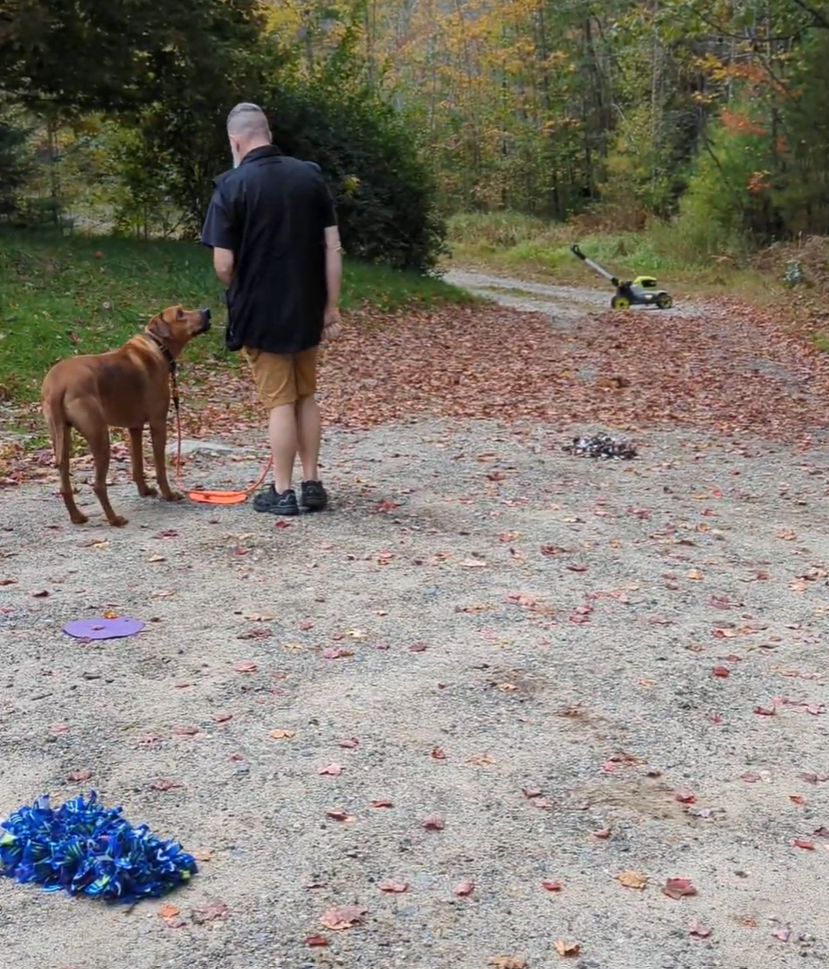
Pattern games are simple, repetitive games that help dogs and cats feel safe in the world. They come from trainer Leslie McDevitt’s Control Unleashed program, and they are one of the most useful tools for dogs who react to other dogs, people, or things on walks, and for cats who are learning to live with another cat. Many board-certified veterinary behaviorists and trainers use them. The steps below work for both dogs and cats, and the section on cats explains a few changes that help.
Why pattern games work
Most training is built on cues. You ask your pet to sit, your pet sits, and your pet earns a treat. For a pet who is worried or frustrated, even a simple cue adds one more thing to think about at a moment when their brain is already overloaded.
Pattern games are different. Each game is a short routine that repeats the same way every time, so your pet always knows what comes next. That predictability is comforting. Pattern games also give your pet choices, such as when to start the next round or when to take a break. Having some control over what happens next helps a pet feel safer, and that sense of safety is the real reward, even more than the treats.
Like any skill, pattern games must be practiced at home first, in a quiet place with no distractions. Many worried or frustrated pets cannot eat or think when a trigger appears, so wait to use the games around triggers until your pet knows them well.
Two words that make the games work
- A start button is something your pet does to tell you they are ready for the next round, most often looking at you. Waiting for your pet’s start button gives them control over the pace of the game.
- A release word, such as “done,” “free,” or “break,” tells your pet the game is over for now and they are free to sniff and explore. Say it in a plain, neutral voice and turn away from your pet.
The Up Down game
The Up Down game is the foundation for the other games, because it teaches voluntary eye contact: your pet learns that looking at you is their choice and that it pays off.
- Place a treat on the floor near your feet. Your pet looks down to eat it.
- Wait. When your pet looks back up at you, say “yes” or click, and place another treat.
- Repeat. Do not call your pet’s name or ask them to look at you. Let them choose to look up.
When your pet is looking up at you quickly after every treat, the game is ready for movement.
The 1, 2, 3 game
The 1, 2, 3 game helps your pet keep moving with you past something surprising.
- Walk with your pet in a quiet place, with treats in the hand closest to them.
- Count out loud, “1, 2, 3,” at a steady pace, and give a treat from your hand on “3.”
- Repeat over and over as you walk. Do not move to get the treat until you say “3.”
Your pet learns that counting means a treat is coming from your hand, so they stay close and keep walking. For a dog on a walk, or a cat moving through the house, the counting becomes a familiar sound that helps your pet move past a trigger. Once your pet knows the game well, you can wait for your pet’s start button, such as a look at you, before you begin counting.
The Whiplash Turn
The Whiplash Turn teaches your pet to turn back to you automatically.
- Place a treat a short distance away from you and move away.
- As your pet finishes eating it, say their name in a cheerful voice.
- When your pet turns their head back toward you, say “yes” and give another treat when they return to you.
With practice, your pet will start turning back to you on their own after eating the tossed treat, even before you say their name. Later, the same automatic check-in can happen when your pet notices something new.
Give Me a Break
Give Me a Break teaches your pet that moving away is a choice they can make, and that working with you is, too. It also helps pets who lose focus or shut down.
- Play a few quick rounds of the Up Down game.
- Place the treat down and turn away from your pet.
- Let your pet sniff or explore. When they choose to come back, mark that behavior, then start the game again.
- Place the treat back in the original location.
Many pets come back faster and more eagerly once they know they can leave. Over time, a pet that practices moving away is more likely to move away from a trigger instead of toward it.
Look at That
Look at That teaches your pet to be a reporter. Instead of staring, pulling, or barking at a trigger, your pet notices it, then turns back to you to “tell” you about it, and earns a reward.
- Start at home with something mildly interesting, such as a wooden spoon, cup, or paper towel roll.
- Present the object. When your pet looks at it, say “yes,” then reward your pet while you return the object behind your back and out of sight.
- Over time, your pet learns that noticing something new cues them to check back in with you.
Look at That is not a way to make your pet meet or interact with the trigger. It teaches the opposite: your pet can notice something and will not be asked to go closer. Do not use Look at That in crowded, busy places where your pet has to process too much at once. The 1, 2, 3 game works better in those situations. Also skip it if your pet is already too upset to eat or turn away.
Scatter Stations
Scatter Stations, once called LATTE, give your pet a soothing way to take in the world. Set out a snuffle mat with hidden food, a small scatter of treats, or a lick mat spread with soft food in a spot where your pet can see what is going on from a comfortable distance. Looking at you starts each round, so your pet chooses when to continue and, later, whether to move a little closer to a trigger. Sniffing, searching, and licking lower arousal and engage the brain’s seeking and exploring system, which helps counter fear and frustration. Scatter Stations are especially helpful for fearful dogs and for cats.
Using pattern games with cats
Pattern games work well for cats, especially during introductions and reintroductions between cats. A few changes help:
- Use tiny, soft treats your cat can eat quickly, or offer a lickable treat on a spoon.
- Keep sessions very short, just a handful of repetitions, and stop while your cat is still interested.
- Start with Up Down, Give Me a Break, and Scatter Stations. These fit naturally with how cats move and explore.
- Adapt the 1, 2, 3 game for deaf cats by using a hand signal instead of counting out loud.
- Practice when the other cat is not around. Bring the games into situations with the other cat only when your cat knows them well, and start with a barrier and plenty of distance.
If your cat will not take even a favorite treat when they see the other cat, they are too upset to learn. Increase the distance and try again later.
Pattern games work best when each cat already has what they need at home. Before you start, read the five pillars of a healthy feline environment and how to choose a litter box, so that no cat has to compete for food, water, litter boxes, or a safe place to rest.
Putting the games to work
Start with the Up Down game and the 1, 2, 3 game at home. When your pet plays them easily, practice in new places, and only then around triggers, starting far away. For dogs, that means your yard and then quiet walks. For cats, it means other rooms, and then a barrier with the other cat at a distance. The goal is not a pet who ignores the world. It is a pet who stays connected to you, notices something surprising, then returns to a routine they trust.
For a full plan for dogs who bark and lunge on walks, read barking and lunging on leash. If your pet’s reactions are getting worse, if your pet has bitten, or if you are worried about safety, talk with your veterinarian and see the Get help page for options.
To learn more, see the Control Unleashed book series by Leslie McDevitt (Clean Run Productions) and Low Stress Handling®: A Practical Guide to Cooperative Care, Training, and Behavior Modification, edited by Christine D. Calder DVM, DACVB, and Pat Koven, LVT, KPA-CTP (CattleDog Publishing, 2025).