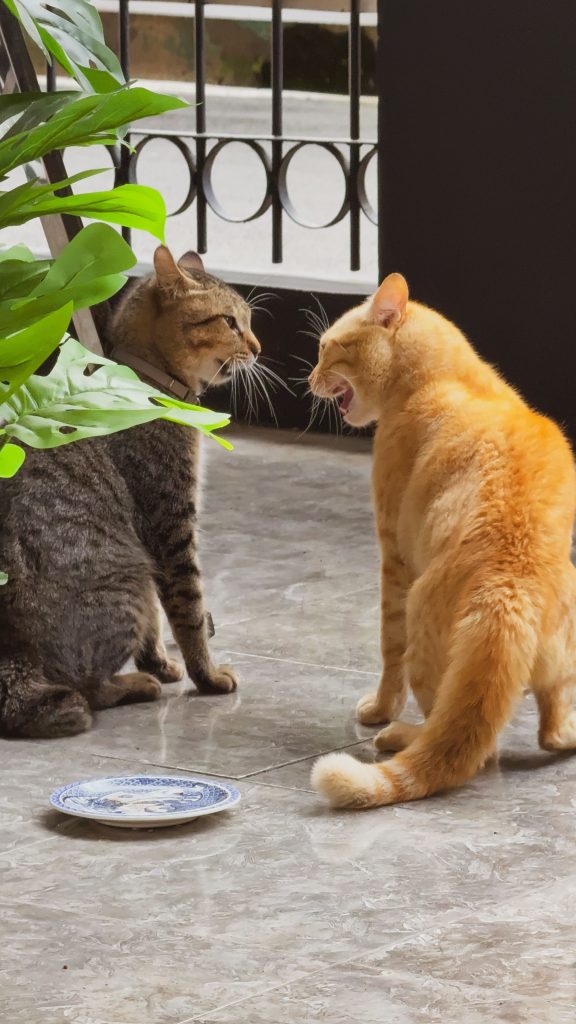
Bringing home a new cat is exciting, but for the cat who already lives in your home, a stranger in their territory can be very stressful. Many cats who fight for years started off on the wrong foot during the first few days. A slow, step-by-step introduction gives both cats the best chance of getting along.
Cats are solitary hunters, and many aren’t naturally as social as dogs. Some cats become close friends, others learn to share a home, and a few never feel comfortable together. Plan on the introduction taking weeks, and sometimes months. Cats usually move more slowly than dogs, so let the cats set the pace.
Core spaces and communal space
Before the new cat comes home, think about your home in two kinds of areas.
- Core space is a cat’s own private area, where they eat, sleep, use the litter box, and feel completely safe. Each cat needs their own core space, and it stays theirs. Cats do not swap core spaces.
- Communal space is the rest of the home, the shared areas the cats will eventually learn to use together, such as a hallway, living room, or kitchen.
For the new cat, set up a separate room as their core space. It should have:
- Food and water
- A litter box
- A scratching post
- A bed or hiding place, such as a covered bed or a box on its side
- Toys and a perch or shelf if possible
Your resident cat’s core space is the area where they already eat, sleep, and spend most of their time. Make sure it exactly the same so the new cat’s arrival doesn’t take anything away from them.
Ask your veterinarian to examine the new cat and test for infectious diseases before the cats share any space.
Step 1: Keep the cats apart
When you bring the new cat home, take them straight to their core space and close the door. For the first several days, or longer, the cats should not see each other. They will hear and smell each other through the door, and that is enough for now.
Spend time with each cat separately. Your resident cat still needs their usual routine, play, and attention.
Step 2: Share scent, not space
Cats learn about each other through smell first. Gently rub a soft cloth on each cat’s cheeks, then leave each cloth in a communal space, away from food bowls, litter boxes, and resting spots, so the other cat can investigate on their own terms.
Watch how each cat reacts. Sniffing with interest, rubbing on the cloth, or ignoring the scent are good signs. Hissing, growling, or avoiding the area means you should go more slowly.
Step 3: Explore the communal space at separate times
Once the new cat is comfortable in their core space, let them explore the communal space while your resident cat is in their own core space with the door closed. Then let your resident cat back out into the communal space. This lets each cat learn the other’s scent in the shared areas while keeping each cat’s core space private and safe.
Do not feed the cats near each other
You may have read that cats should eat on either side of a closed door. Because cats are solitary hunters, eating near another cat, even one they cannot see, can be stressful. Feed each cat in their own core space, away from the other cat, for the whole introduction and afterward.
Step 4: Teach pattern games to each cat
Instead of using food bowls to bring the cats together, use pattern games. These simple, predictable games, from trainer Leslie McDevitt’s Control Unleashed program, work for cats as well as dogs. Teach each cat separately, when the other cat isn’t around, so the games are easy and familiar before you need them.
- Up Down. Place a treat on the floor at your feet. When your cat eats it and looks back up at you on their own, place another one in the same spot. This reinforces voluntary eye contact and lays the foundation for the other games.
- Give Me a Break. After a few rounds, place a treat away from you and wait. Your cat learns that moving away is a choice, and later, they are more likely to move away from the other cat instead of toward them.
- Scatter Stations, once called LATTE. Your cat sniffs and searches for treats scattered in a small area or on a snuffle mat. Looking at you starts each round, so your cat chooses when to continue. Sniffing and searching for food lowers arousal and engages the brain’s seeking and exploring system, which helps counter fear and frustration.
- 1, 2, 3. Count “1, 2, 3” and give a treat on “3” repeatedly so your cat learns a predictable routine. For a deaf cat, use a hand signal instead of counting out loud.
Keep sessions short, just a handful of repetitions, and stop while your cat is still interested. Use very small, soft treats your cat can eat quickly, or a lickable treat on a spoon. These games may feel simple, and that is the point. No task needs to be performed and there’s no wrong answer, just a routine your cat can count on. Read more in pattern games for dogs and cats.
Step 5: Let them see each other with a barrier
When both cats know the games well, let them see each other through a barrier, such as a baby gate, two stacked baby gates, a screen door, or a door propped open just a crack. Start at a distance where both cats can still eat and play. Each cat can notice the other, then return to the familiar routine on their own.
If a cat will not take even a favorite treat, stares and cannot look away, or will not play the game, they are too upset to learn. Add distance or close the door, and try again another day from farther away.
Keep these sessions short, and end while both cats are still relaxed.
Step 6: Short, supervised time in the communal space
When the cats can see each other through the barrier and keep playing the games, let them share the communal space for a short time while you watch. Keep the pattern games going, keep visits brief, and slowly make them longer. Each cat should always be able to leave and go back to their own core space. Keep the cats separated when you cannot supervise them until you are confident they are comfortable together.
Signs to slow down
Go back a step if you see:
- Hissing, growling, spitting, or swatting
- Staring, or one cat blocking the other from food, litter boxes, or doorways
- A cat hiding more, eating less, or not using the litter box
- Ears flattened, a puffed tail, or a low, crouched body
Going back a step is not failure. It is how a slow introduction works.
Make sure there is enough for everyone
Cats get along better when they do not have to compete. Provide separate food and water bowls, scratching posts, resting spots, and hiding places in different parts of the home. Plan on one litter box per cat, plus one, in different locations. Read more in the five pillars of a healthy feline environment and how to choose a litter box.
If the cats fight
Do not let the cats “work it out.” Fights can cause serious injuries and can make the cats afraid of each other for a long time. Never reach between fighting cats with your hands. Make a loud noise or slide a cushion, piece of cardboard, or baby gate between them. Then separate them, give each cat time to recover in their own core space, and start the introduction again from an earlier step.
When to get help
Contact your veterinarian if either cat stops eating, hides most of the time, stops using the litter box, is injured, or if the introduction is not improving after several weeks. For some cats, medication is an important part of helping them feel safe enough to learn. A board-certified veterinary behaviorist can help you create a plan for your cats, including how to adapt the games for your cat and when to move to the next step. See the Get help page for options.