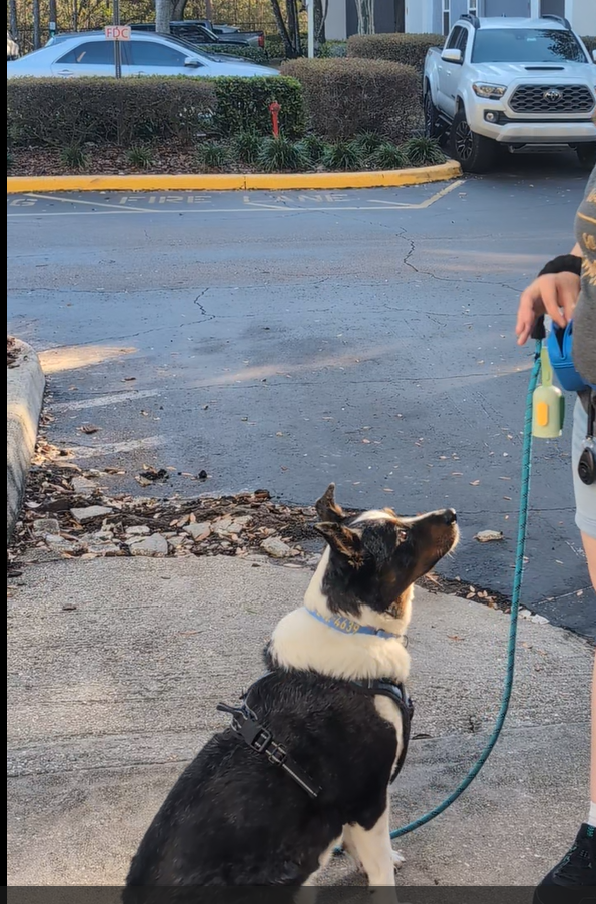
Many dogs who are fine at home bark, lunge, growl, or spin at the end of the leash when they see another dog, a person, a bike, or a car. This is often called leash reactivity. It can make walks stressful and embarrassing, and many families start walking their dog less, or only late at night. Leash reactivity is not a dog being difficult. It is a strong emotional response, and with the right plan, most dogs can learn to feel differently about the things they see on walks.
Why the leash changes everything
Off leash, an uncomfortable dog has choices. They can move away, curve around the other dog, or put more distance between them. On leash, those choices disappear.
When a fearful dog cannot move away, the backup plan is to bark and lunge to make the scary thing go away. When a frustrated dog cannot get to something they want, the leash becomes a barrier, and the emotion builds until it spills over.
Fear or frustration?
Watching your dog’s body language can give you clues about which emotion is driving the reaction:
- Fear: Your dog is trying to create distance. Look for a low body posture, ears pulled back, a tucked tail, and attempts to back away or retreat between lunges.
- Frustration: Your dog is trying to get closer. Look for a forward-leaning body, a high tail, and intense focus on the other dog or person. These dogs are often social with other dogs off leash, but they become frustrated when they are held back. When the frustration builds and has nowhere to go, some dogs redirect it onto whatever is closest. They may grab or bite the leash, nip or bite their person, or turn on another dog walking with them.
Some dogs feel both, and it can be hard to tell the difference in the moment. Video of a walk can help. The difference matters because fear and frustration require different plans, and treating one as the other can make reactions worse.
Past experiences matter too. A dog who was attacked, or who was punished when they saw other dogs, may now expect something scary or unpleasant to happen when another dog appears.
What happens in your dog’s body
When your dog sees a trigger, two stress systems turn on. The first releases adrenaline for an immediate reaction, which is why reactions happen so fast. The second releases cortisol, which keeps the body on alert long after the trigger is gone. A dog who reacts on a walk may stay on edge for hours, or even days, afterward.
This leads to something called trigger stacking. Trigger stacking happens when stressful events pile up one after another before your dog’s body has time to recover. A dog who can handle seeing one dog across the street may be fine. But if they have already been startled by a loud truck, then passed a barking dog behind a fence, the next dog they see may be the one that sends them over the edge. The reaction may look like it came out of nowhere, but it is really the result of everything that came before.
Over time, a dog that gets triggered repeatedly can get worse at recovering, and more reactive, not less.
More exposure is not the answer
Many caregivers are told that their dog just needs more socialization, and that taking them to the dog park, a pet store, or a busy downtown street will help them “get over it.” For most reactive dogs, this doesn’t work and often makes reactions worse.
Socialization is a window of time early in a puppy’s life, roughly between 3 and 14 weeks of age, when puppies learn most easily that new people, dogs, and places are safe. Most reactive dogs are well past that window. For an adult dog who is already fearful or frustrated, being surrounded by triggers in a place they cannot leave is overwhelming. Each of those experiences is practice in reacting; it adds to trigger stacking and can teach a fearful dog that the world is even scarier than they thought.
Instead of more exposure, reactive dogs need fewer triggers, a lot of practice at home, and a slow, careful plan that lets them succeed.
Step 1: Start with your veterinarian
Ask your veterinarian to check for pain, gastrointestinal disease, or other medical conditions, especially if your dog’s reactions started suddenly or as an adult. A dog who hurts is more irritable and more easily startled. Read more about hidden pain in dogs.
Whether medication will help depends on what is driving your dog’s reactions. For fearful dogs, medication is an important part of the plan. It can lower your dog’s emotional baseline so they don’t start every walk already on edge, and it helps them learn new skills more easily. For frustrated dogs, medication may not help, and training is the main part of the plan. Talk with your veterinarian to find out what’s right for your dog.
Step 2: Take a break from triggers
Before training begins, your dog’s stress system needs time to recover. For the next few weeks, avoid situations that trigger reactions as much as you can.
- Walk at quiet times and in quiet places where you are unlikely to meet triggers.
- Try a sniff walk. Let your dog wander slowly and sniff at their own pace, on a long line in a safe, open area if possible. Sniffing is relaxing and mentally tiring for dogs.
- On some days, skip walks and replace them with games at home, such as food puzzles, scatter feeding, nose work, or treat-based hide-and-seek.
- Drive to a quiet park, trail, or empty field instead of walking through a busy neighborhood.
A break is not giving up. It gives your dog’s body a chance to settle so learning is possible.
Choose equipment that does not hurt
Use a well-fitted harness that clips on the chest or back, plus a regular 6-foot leash, or a long line for sniff walks in open areas. Avoid collars that tighten, choke, prong, or shock. These tools cause pain and can result in frustration. When pain happens every time your dog sees another dog, your dog can also learn to feel worse about other dogs. Retractable leashes give you less control and can cause injuries.
Step 3: Build skills at home first
When a trigger appears, many reactive dogs cannot eat, even their favorite treats, and cannot respond to cues they know well. That is why you need to practice every skill in this plan at home first, in a quiet place with no distractions, such as your living room or backyard. Do not use these skills on walks until your dog knows them well. Practice when your dog is relaxed, keep sessions short and fun, and use small, high-value treats.
- Pattern games. Pattern games, from trainer Leslie McDevitt’s Control Unleashed program, give your dog a predictable routine that helps them feel safe. Start with the Up Down game and the 1, 2, 3 game. Step-by-step instructions are in pattern games for dogs.
- Hand-to-nose targeting and the U-turn. Teach your dog to touch their nose to your open hand for a treat. Then use the hand target to teach a quick U-turn: say an upbeat cue such as “This way!”, turn, offer your hand, and reward your dog when they turn with you and touch it. This lets you leave a situation quickly before your dog reacts.
- Voluntary eye contact. Reward your dog every time they choose to look at you on their own, without you calling their name or asking for it. The Up Down game is a great way to teach this. A dog who checks in with you on their own builds the habit that matters most on walks.
- Relaxing on a mat. Teach your dog that lying on a mat or towel means good things happen. This skill helps at cafes, during veterinary visits, and when settling after a walk.
Managing triggers on walks
Even with a break from triggers, you may still unexpectedly meet another dog or person. When that happens, the goal is to get through it without a reaction.
- Walk one dog per person. Walk a reactive dog alone, or with one person per dog. It is very hard to manage two or more dogs when one of them is reactive, and a frustrated dog may redirect onto the dog walking beside them.
- Keep moving. Do not ask your dog to sit or to wait for the trigger to pass. Standing still while a trigger gets closer is very hard for a reactive dog. Keep your dog engaged with you and keep walking, using the 1-2-3 game or a U-turn.
- Hide. Step behind a parked car, a building, a hedge, or another object that blocks your dog’s view until the trigger has passed.
- Make a sticky treat station. Smear a little soft food, such as squeeze cheese or a dog-safe spread, on a tree trunk or post at your dog’s nose level, and let your dog lick it while the trigger goes by.
- Scatter feed in the grass. Toss a handful of small treats into the grass so your dog can sniff and search for them while the trigger passes. Sniffing helps many dogs relax.
Step 4: Use the right plan for your dog
When your dog knows the foundation skills well at home, start using them on walks, far away from triggers. Every dog has a distance where they can notice another dog and still stay relaxed enough to eat treats and play the games they know. Closer than that, they react. Go slowly. If your dog barks or lunges, you are too close. Move away calmly, give your dog time to recover, and start farther away next time.
The key to all of this is engagement with you. The goal is a dog who stays connected to you and keeps moving with you, not one who simply gets used to other dogs. What you practice depends on whether your dog is fearful or frustrated.
For fearful dogs: change how the trigger feels
A fearful dog needs to learn that other dogs, people, or bikes predict good things instead of scary ones.
- Treats when the trigger appears. When your dog sees a trigger at a distance where they can stay relaxed, give them a high-value treat, such as small pieces of chicken or cheese. Keep the treats coming while the trigger is in view, and stop when it leaves. Your dog does not have to do anything to earn the treats. Over time, your dog learns that the trigger predicts good things and becomes more comfortable when they see it.
- Scatter Stations. Scatter Stations, once called LATTE, is another Control Unleashed exercise. Your dog sniffs for food on a snuffle mat or licks a lick mat at a spot where they can watch the world from a comfortable distance. See pattern games for dogs for how to set them up.
For frustrated dogs: teach a new behavior that pays off
A frustrated dog already feels good about other dogs. They just cannot get to them. Instead of giving treats just for seeing the trigger, teach your dog a new behavior when they see another dog, and reward them every time. This approach is called operant counterconditioning.
- Look at That, another Control Unleashed game, teaches your dog to be a reporter. Your dog notices the other dog, then turns back to you to “tell” you about it, and earns a reward. Learn how to teach it in pattern games for dogs.
- The U-turn with a hand target or voluntary eye contact you practiced at home can also become your dog’s new response.
- For dogs who love other dogs, the reward can be the chance to sniff or greet a friendly, familiar dog after your dog stays relaxed and offers the new behavior.
With practice, seeing another dog becomes a cue for your dog to check in with you, instead of a reason to bark and pull.
What not to do
- Do not punish your dog for reacting. Yanking the leash, yelling, or using painful tools may stop the barking for a moment, but it adds fear and pain and can make reactions worse.
- Do not force your dog toward a trigger, or make them sit and wait for it to pass. Making a frightened or frustrated dog get closer to what upsets them, or hold still while it approaches, usually makes things harder.
- Do not hold your dog in place. Grabbing, hugging, or pinning a dog who is reacting will not settle them. A frightened or frustrated dog who is held is likely to redirect, and you are likely to get bitten.
- Do not take your dog to dog parks or crowded places to help them get used to triggers. Flooding a reactive dog with triggers usually makes reactions worse.
- Do not let other dogs rush up to your dog. It is okay to call out, “Please give us space!”
When to get help
If your dog’s reactions are getting worse, if your dog has bitten or tried to bite, or if walks feel unsafe, contact your veterinarian. A board-certified veterinary behaviorist can help you figure out whether fear, frustration, pain, or a mix is driving your dog’s behavior, and build a step-by-step plan with you. A qualified, reward-based trainer can also help you practice the skills. See the Get help page for options.
To learn more, see the Control Unleashed book series by Leslie McDevitt (Clean Run Productions) and Low Stress Handling®: A Practical Guide to Cooperative Care, Training, and Behavior Modification, edited by Christine D. Calder DVM, DACVB, and Pat Koven, LVT, KPA-CTP (CattleDog Publishing, 2025).