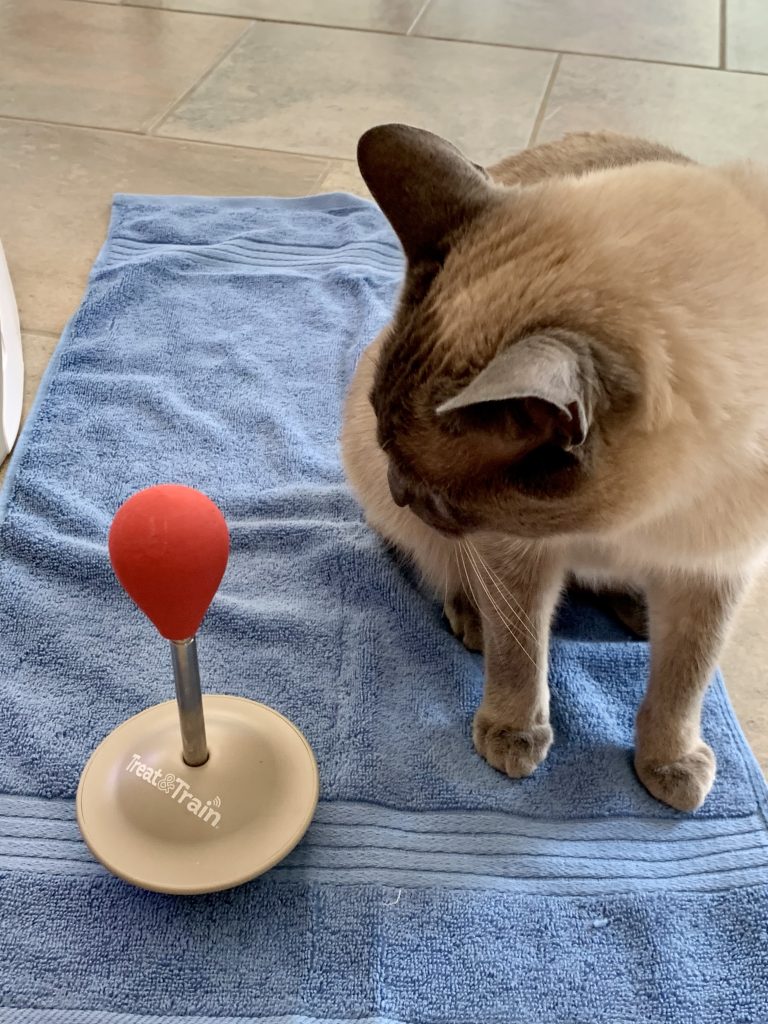
“Cooperative care” has become a popular phrase. But a pet who holds still for a nail trim is not always cooperating. Some animals hold still because they are relaxed and willing. Others hold still because they are frozen with fear, or because they have learned that struggling does not work. To provide truly cooperative care, we need to understand the difference between assent, consent, tolerance, and coercion.
Four words that sound alike but are not
Consent
Consent is agreement given before something happens, with an understanding of what will happen and the risks. People can give informed consent for a medical procedure. Animals cannot, because they cannot understand in advance what a vaccine, a blood draw, or surgery involves. For animals, caregivers give consent on their behalf, with advice from their veterinarian.
Assent
Assent is an animal’s ongoing agreement to take part, shown through their behavior, moment by moment. Unlike consent, assent is not given once at the start. It must continue throughout the interaction, and the animal can withdraw it at any time.
Assent is only meaningful when the animal has a real choice. If an animal has no other way to get what they need, or if saying no leads to something unpleasant, their participation is not true assent.
Examples of assent behaviors include:
- Offering a start button, such as a chin rest, eye contact, or stepping onto a mat. Read about start buttons in cooperative care.
- Approaching, leaning in, and staying in position without being held.
- Relaxed body language, with soft eyes, loose muscles, and normal breathing.
Examples of assent withdrawal include lifting the chin, stepping off the mat, looking away, moving away, freezing, lip licking, tensing, or growling. When an animal withdraws assent, the session stops.
Tolerance
Tolerance means the animal is putting up with something. They are not fighting, but they are not agreeing either. A tolerant animal may hold very still, look away, have tense muscles, breathe quickly, or wait for it to be over. Tolerance is often mistaken for cooperation, because the animal is quiet and the procedure gets done.
Some animals who look the most “well-behaved” during handling are actually frozen with fear. Freezing is one of the body’s natural responses to threat. A dog or cat that has learned struggling never works may stop struggling, but that doesn’t mean they feel safe. Over time, repeated handling that is only tolerated can worsen fear, and some animals who tolerated handling for years eventually bite.
Coercion
Coercion means getting an animal to take part by removing other options or by making non-participation unpleasant. Restraint, force, flooding (keeping an animal in a scary situation until they stop reacting), and punishment are obvious forms of coercion.
Coercion can also be less obvious. Even positive reinforcement can be coercive if an animal can get something they need only by accepting something they fear. A very hungry animal that must accept handling to eat, or a frightened dog that takes treats while being held near something scary, may participate, but they do not have a real choice. Researchers have described cases where animals appeared to be working for food when they were actually trying to get the session over with.
Degrees of freedom
Behavior analyst Dr. Israel Goldiamond taught that real choice exists only when an animal has more than one way to get something that matters to them. The number of options is called degrees of freedom. If there is only one way to get the reward, participation is effectively coerced. Read more about degrees of freedom and choice.
In true cooperative care, saying no is a real option, and saying no is not punished. The best programs go further: the animal can decline and still earn reinforcement. In one zoo example, a leopard was taught to ring a bell to decline a behavior and still receive a reward. Another option, such as a different behavior or a break, is always available.
Looking at all the consequences
Traditional training often looks at one behavior and one consequence at a time: the dog holds still, the dog gets a treat. But animals balance many consequences at once. A cat at the veterinary hospital may want the treat, but also want to escape the strange smells, the restraint, and the person reaching toward them. Nonlinear contingency analysis, developed from Goldiamond’s work by Dr. T. V. Joe Layng and colleagues, considers these competing consequences together, including how the animal feels.
This matters because a new reward layered on top of an unaddressed fear does not remove the fear. Feeding a dog treats while a stranger reaches for them may get the dog to stand still, but the dog may still be afraid. True cooperative care changes the whole situation, so the animal does not need to escape.
The constructional approach
The constructional approach, first described by Goldiamond in 1974, focuses on building new behavior rather than eliminating unwanted behavior. Instead of asking, “How do I stop this?” it asks, “What does this animal need, and how can I help them get it in a better way?” The plan starts with what the animal can already do comfortably, and builds from there in small steps, always keeping more than one option open.
Zoos have used this approach to help animals take part in their own care, from voluntary blood draws to stepping onto scales, with the animal free to leave at any time.
What true cooperative care looks like
- The animal can say no. The animal has a clear way to stop the session, and you respect it every time.
- Saying no is safe. Declining does not lead to restraint, punishment, or losing access to something important.
- There is more than one option. The animal can take part, take a break, do something else, or leave.
- Emotions are watched, not just behavior. You look for relaxed body language, not just stillness.
- Steps are small. You move forward only when the animal is comfortable, and go back when they are not.
- The animal starts each step. A start button lets the animal tell you they are ready.
When care cannot wait
Sometimes animals need care that cannot wait for training, such as in an emergency or when a pet is very sick. In these cases, the kindest choice may be pre-visit medication or sedation, prescribed by your veterinarian, so the animal experiences as little fear as possible. This is not cooperative care, but it is humane care, and it prevents a scary experience from undoing your training. Then you can return to building skills.
Questions to ask yourself
- Can my pet say no? What happens when they do?
- Is my pet relaxed, or frozen and waiting for it to be over?
- Am I using food to get my pet through something they fear?
- Does my pet have more than one way to get what they want?
- Is my pet choosing to come back for more?
If you are not sure, take a video and watch it later, or ask a qualified, reward-based trainer or your veterinary team to help. Read what Low Stress Handling® means and how to choose a trainer.
Resources
- AnimalKind, the BC SPCA’s accreditation program for humane dog training, has resources on humane training and choosing pet care services.
- Behavior Works, Dr. Susan Friedman’s website, has articles on choice, control, and the humane hierarchy.
Sources: Heidenreich B, Pedersen A. The constructional approach to zoo animal training: enhancing welfare through emerging evidence-based behavioral science. Animals. 2025;15(21):3221. Goldiamond I. Toward a constructional approach to social problems: ethical and constitutional issues raised by applied behavior analysis. Behaviorism. 1974;2(1):1-84. Layng TVJ, Andronis PT, Codd RT, Abdel-Jalil A. Nonlinear Contingency Analysis: Going Beyond Cognition and Behavior in Clinical Practice. Routledge; 2021. Englund MD, Cronin KA. Choice, control, and animal welfare: definitions and essential inquiries to advance animal welfare science. Frontiers in Veterinary Science. 2023;10:1250251.